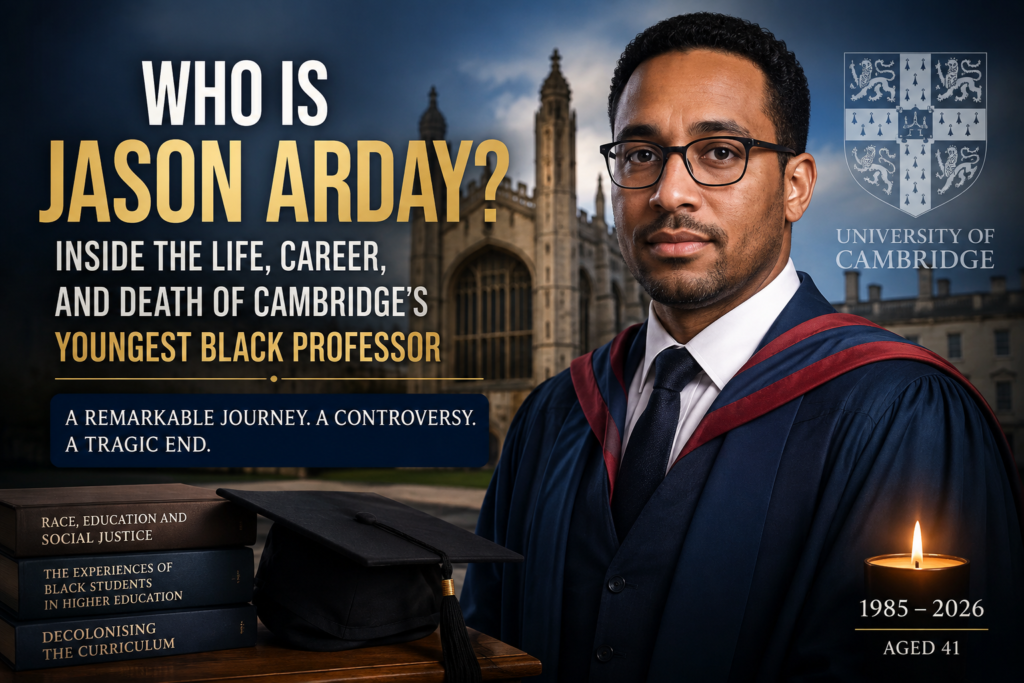
Jason Arday’s story once stood as one of the most remarkable in modern British academia: a boy who did not speak until age 11 and could not read or write until 18 who went on to become the youngest Black professor in the history of the University of Cambridge. In August 2026, that story took a devastating turn — Arday resigned from Cambridge amid plagiarism allegations and was found dead in London days later, at age 41. This article brings together the verified facts of his life, career, the controversy that engulfed his final weeks, and his death, drawn from official university statements and major news outlets.
Quick Facts About Jason Arday
| Detail | Information |
|---|---|
| Full name | Jason Arday |
| Known for | Youngest Black professor ever appointed at the University of Cambridge |
| Field | Sociology of Education |
| Appointed to Cambridge | March 2023, at age 37 |
| Previous roles | University of Glasgow (Professor, 2021), Durham University (Associate Professor), Roehampton University (Senior Lecturer) |
| PhD | Liverpool John Moores University, 2016 |
| Diagnoses disclosed | Global developmental delay and autism spectrum disorder, diagnosed at age 3; dyslexia |
| Notable personal history | Did not speak until age 11; could not read or write until 18 |
| Olympic connection | London 2012 Olympic Torch Bearer, following a 2010 fundraising challenge in which he ran 30 marathons in 35 days |
| Resigned from Cambridge | August 5, 2026, amid plagiarism allegations |
| Died | August 14, 2026, in London, aged 41 |
Early Life and Extraordinary Personal Story
Arday’s public profile was built on an account of overcoming severe early-life challenges. According to his own statements and interviews reported by outlets including the Guardian, he was diagnosed with global developmental delay and autism spectrum disorder as a young child, did not speak until he was 11 years old, and was unable to read or write until he was 18. He credited his mother’s persistence and support with helping him access education despite these barriers.
Before his rise in academia, Arday was known for a remarkable athletic fundraising feat: in 2010, he ran 30 marathons in 35 days to raise money for the housing charity Shelter and the Shooting Star Children’s Hospice. That effort led to his selection as a Torch Bearer for the London 2012 Olympic Games.
Academic Career: From Rejected Papers to a Cambridge Professorship
Arday’s academic path began later than most in his field, and by his own account, it was not easy. He has described his first attempts at academic publishing as being “violently rejected,” saying he had no mentor and no one to teach him how to write academic papers. He eventually published his first peer-reviewed paper in 2018.
His career milestones included:
- PhD, awarded by Liverpool John Moores University in 2016
- Senior Lectureship at the University of Roehampton (2018)
- Associate Professor of Sociology at Durham University
- Professor of Sociology of Education at the University of Glasgow (2021), where he was described in press coverage as one of the youngest professors in Britain and the youngest Black professor in the UK at the time
- Professor of Sociology of Education at the University of Cambridge (from March 2023), becoming, at 37, the youngest Black person ever appointed to a professorship at Cambridge and one of the youngest people ever to hold a professorial chair in Oxbridge’s history
As a scholar, Arday published extensively on race, inequality, and education, focusing on subjects such as the experiences of Black students in higher education, the under-representation of ethnic minority academics, inclusive pedagogy, and decolonising the curriculum. He authored two academic books and was working on a memoir, Great and Unfortunate Things, recounting his journey from childhood diagnosis to a Cambridge professorship.
The Plagiarism Allegations and Resignation
In the weeks before his death, Arday came under sustained media and academic scrutiny. Questions were raised publicly about alleged plagiarism in parts of his academic work, as well as about some claims associated with his biography, including aspects of his athletic and fundraising accomplishments. The University of Cambridge said it opened a formal investigation “following new information about Professor Arday’s qualifications and honorary appointments,” and Cambridge’s Vice-Chancellor, Professor Deborah Prentice, indicated the university would review its hiring processes as a result.
Arday said any errors in his academic work were inadvertent and denied any intentional wrongdoing, characterizing much of the criticism against him as part of an ideologically and racially motivated campaign. Notably, Liverpool John Moores University, which awarded his PhD, had previously investigated allegations relating to his doctoral thesis and said it found no evidence of academic misconduct, according to reporting by The Times of London.
Separately, reporting by The Times of London and The Telegraph raised questions about possible embellishments in parts of Arday’s personal history — including claims about the amount of money he raised for charity through his endurance fundraising challenges, which he later amended, and a claim regarding a published book that The Telegraph also questioned.
On August 5, 2026, Arday resigned from his position as Professor of Sociology of Education at Cambridge, stating that “the relentless accusations, speculation and public commentary have taken a profound toll on me and on those I love,” and adding that his resignation should not “be mistaken for an acceptance of the narratives that have surrounded me.”
More than two dozen academics and public figures publicly described the allegations against him as a “smear campaign” intended to undermine Arday and other Black academics in prominent positions. Cambridge’s Vice-Chancellor also stated that the situation was “an aberration” that should not be used to cast doubt on the legitimacy or achievements of the university’s staff of color more broadly.
Jason Arday’s Death
Jason Arday was found dead in a property in London on Friday, August 14, 2026, a week after his resignation from Cambridge. London’s Metropolitan Police said officers responded to a report of a 41-year-old man found unresponsive at approximately 3:12 p.m. local time; police did not publicly identify him by name in their statement, but his family and the University of Cambridge confirmed his death.
In a statement, Arday’s family said: “Jason was subjected to a campaign of sustained abuse for the more than three years since he accepted the role of Professor at Cambridge University by those who would leave no stone unturned in their quest to undermine him. The campaign of misinformation was too much for Jason, who was a gentle man and who always wanted to see the best in everyone. We are in shock to have lost this amazing father, partner, brother, uncle and son.”
Police said Arday was pronounced dead at the scene and that his next of kin have been notified and are being supported by officers. Authorities described his death as “unexpected, but is not believed to be suspicious,” and said the case remains under investigation; no further cause-of-death details have been made public as of this writing.
Cambridge Vice-Chancellor Deborah Prentice responded: “We are desperately saddened to hear this tragic news. Our heartfelt sympathies go to Jason Arday’s family and friends at this incredibly difficult time.” UK Education Secretary Lucy Powell also commented publicly, saying she was “deeply shocked & saddened” by the news and extending her condolences to Arday’s family and friends. The University of Cambridge has said it will separately investigate the circumstances surrounding Arday’s employment.
Why Jason Arday’s Story Resonated Globally
Before the controversy of his final weeks, Arday’s rise was widely covered as an inspiring story of resilience: a nonverbal, non-reading child who became one of the most prominent Black academics in the UK, using his platform to advocate for greater representation of Black, Asian, and minority ethnic scholars in higher education. His case had been cited by educators, disability advocates, and diversity campaigners as a powerful example of what support, persistence, and access to education can achieve — which is part of why the plagiarism allegations, his resignation, and his subsequent death drew such intense international attention.
Frequently Asked Questions About Jason Arday
Who was Jason Arday?
Jason Arday was a British sociologist who became the youngest Black professor in the history of the University of Cambridge when he was appointed Professor of Sociology of Education in March 2023, at age 37. He specialized in research on race, inequality, and higher education.
Why was Jason Arday famous?
He was known both for his academic achievements — becoming Cambridge’s youngest Black professor after previously holding professorships at the University of Glasgow — and for his personal story of overcoming a childhood diagnosis of autism and global developmental delay, not speaking until age 11 and not reading or writing until age 18.
What were the plagiarism allegations against Jason Arday?
In mid-2026, Arday faced public allegations of plagiarism in parts of his academic work, along with questions about certain claims in his biography. The University of Cambridge opened an investigation into his qualifications and honorary appointments. Arday denied the plagiarism claims but admitted to some mistakes made while completing his doctorate.
Did Jason Arday resign from Cambridge?
Yes. Arday resigned from his position as Professor of Sociology of Education at the University of Cambridge on August 5, 2026, citing the toll that “relentless accusations, speculation and public commentary” had taken on him and his family.
When and how did Jason Arday die?
Jason Arday was found dead at his home in London on August 14, 2026, one week after his resignation from Cambridge. He was 41 years old. London’s Metropolitan Police said officers responded to a report of an unresponsive man at a property that afternoon and pronounced him dead at the scene. Police described the death as “unexpected, but is not believed to be suspicious,” and the case remains under investigation. A specific medical cause of death has not been made public.
Was Jason Arday cleared of academic misconduct?
Liverpool John Moores University, which awarded his PhD, had previously investigated allegations concerning his doctoral thesis and reported finding no evidence of academic misconduct, according to The Times of London. Arday maintained that any errors in his broader academic work were unintentional.
What did Jason Arday’s family say after his death? His family described him as having faced “a campaign of sustained abuse” over more than three years since he joined Cambridge, and called the misinformation surrounding him unbearable. They remembered him as “a gentle man” and “amazing father, partner, brother, uncle and son.”
What was Jason Arday’s academic background before Cambridge? He earned his PhD from Liverpool John Moores University in 2016, then held a Senior Lectureship at the University of Roehampton, an Associate Professorship at Durham University, and a full Professorship of Sociology of Education at the University of Glasgow before joining Cambridge in 2023.
Was Jason Arday connected to the London 2012 Olympics? Yes. After running 30 marathons in 35 days in 2010 to raise money for the charity Shelter and the Shooting Star Children’s Hospice, Arday was selected as a Torch Bearer for the London 2012 Olympic Games.
If you or someone you know is struggling with grief, harassment, or mental health difficulties, support is available. In the UK, Samaritans can be reached free, any time, on 116 123.
References and Further Reading
- University of Cambridge Faculty of Education — Jason Arday appointment announcement
- The Guardian — “Jason Arday: he learned to talk at 11 and read at 18 – then became Cambridge’s youngest Black professor”
- PBS NewsHour — “Jason Arday, youngest Black professor at Cambridge, found dead at 41 after resignation”
- CBS News — “Jason Arday, former Cambridge professor, dies week after resigning amid plagiarism allegations”
- The Washington Post — “Youngest Black professor at Cambridge who faced plagiarism claims is found dead”
- Wikipedia — Jason Arday
- NBC News — “Jason Arday, ex-Cambridge professor accused of plagiarism, found dead week after resigning”
Related reading on Expat Living Guide: